Showing posts with label reading. Show all posts

Thursday, 10 August 2023

Even more reasons to share a book or shoot the breeze with our tamariki.


I want to start this blog by celebrating the word 'Ako'. Unlike the word 'teach' in English (implying one-way traffic from the teacher to the learner), 'ako' contains the concepts of both teaching and learning. This beautifully conveys how we experience life as kaiako: we hope to pass on a little learning, but daily find ourselves learning just as much in return from our students! Added to this, ongoing study to keep our skills sharp is part of the mix. 

Right now, the Junior team is doing some literacy study with the University of Canterbury. We will definitely be sharing lots more on this with you - and soon. But for now, I thought I'd share one small nugget of learning that spoke to me as a parent, as well as a teacher. 

Oral narrative skills: the ability to tell or retell fictional stories

Kaiako are always keen to encourage whānau to share books together. We also know that a rich, oral language environment at home (lots of talk with lots of different words - in any language or languages) helps children when they start school. Our recent studies have focussed especially on the skill of oral storytelling (oral narrative skills).

Our children's oral narrative skills are important in the early years of school. They help children to take part in classroom life and connect with subjects from across the curriculum. Our students bring a lot of knowledge with them to school. They learn best when they can connect new ideas with what they already know. Sharing knowledge and experiences is part of this. For children, sharing often in the form of a simple story. Sound oral language skills enable children to share ideas with others and to build on what they already know.


Research now also shows us that a child's ability to retell a story is a predictor of their success at school, particularly at reading comprehension. Reading comprehension means being able to understand fully what a text means. It is possible to decode and 'read' a story without really understanding it. The Simple View of Reading suggests that good readers combine efficient decoding (identifying the sounds in a word and blending them together) with comprehension skills to make sense of what they are reading. In other words, for our children to be good readers, we need to work on both decoding and comprehension.

To understand what we are reading, we use our vocabulary knowledge plus general and subject-specific knowledge. If we have experienced other similar stories or texts, this helps us, too. For children, sharing books and stories with an adult is very beneficial. An adult reader can help them to understand new words and check their understanding of the story by asking questions and retelling the tricky parts. Adult readers can also provide extra information and context around the story to support the child's understanding and build their general knowledge.

And there is more. Enjoyed reading a story or watching a movie together? Now try retelling that story with your child, perhaps while walking or driving together. Who is in the story? How did the story begin? What happened next? What was the exciting bit? How did the story end up? Storytelling opens up golden opportunities to practice oral language skills and sequencing (arranging things in order). You could also try making up a silly story together. Or ask your child: "Tell me about something that happened at school today." This is worth persevering with even if, like me, you sometimes get the response, "I can't remember!"

In telling even the simplest story, your child will need to use their language skills at text level (choosing the right individual words), sentence level (putting the words together in the right order to create meaning) and text level (sequencing events to tell the story). There is a lot of wonderful, rich learning going on here - as well as connecting and sharing. 


Thursday, 10 June 2021

Exploring literacy


This week we have been enjoying some different ways of exploring literacy. From writing super sentences (with capital letters and fullstops) to reading with a friend we are up to the challenge of trying new things. Check out some examples of our learning.


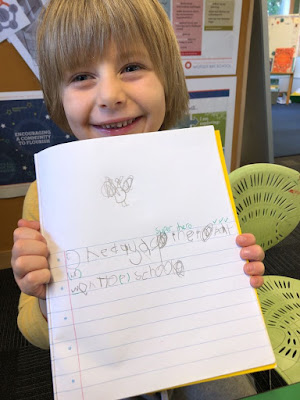
Everyone has their own writing goals and next steps. Some children were working on writing a super sentence. We love to make writing about experiences or something fun to get the ideas flowing. This story is about something strange happening. 
"One day a super hero bat came to school"
I wonder what could happen next?


We are using a listening post to hear stories that we have been reading. Being read to models fluency and making our reading sound like talking.


We have been creating art to go with our stories. Sometimes the art inspires the writing and sometimes the writing inspires the art.

Beth showed us through the Library and we got to explore and take some books home to share with our families.

Here we are reading and sharing stories we have read with our friends. Sharing books is a great way to practice and grow our reading mileage.

What ways do you explore literacy at home? Share them with us so we can grow our love of literacy.


Tuesday, 8 December 2020

Making books


In Autahi, we love sharing books of all kinds. Reading great books inspires us to tell and write our own stories. For a little while now, our writers have been asking to make books. So, this week, the Autahi is exploring how books are made so that we can make some beautiful books of our own.

We have been looking closely at some different kinds of books and noticing the some have hard covers and some have soft, paperback covers. Some have wire staples, and some are stitched together with thread. We have been learning about what goes on the front and back covers of books to help readers to know that might be inside. And we have been finding out that books have spines, just like us!

We have been working on writing and illustrating some books of our own. Some of us are writing stories. There is some non-fiction, and also a graphic novel on the go.


We are beginning to share some of our books with our friends in class. Because we know that other people will want to read our stories, we are taking extra care to reread them and add some cool illustrations. 


We are also working on creating some hardback books. We learnt that the hard cover of a book is called the 'case' and we talked about how precious things are sometimes kept in cases to keep them safe. Stories are treasures, too, so we want to make our books as beautiful as we can.

Here we are printing and painting a special piece of paper to wrap around our book's case.

Thursday, 23 April 2020

Top Tips for Learning Rocket Words

How do you practise your Rocket Words?

Here are some handy tips that you've been sharing.

Rocket Words are common words that appear a lot in our books. The aim is to learn them so that we can recognise and read them straight away. Our brains get good at recognising the shape of familiar words so we don't have to use other strategies like Stretchy Snake to read them. This has been shown to speed up reading and make it more fluent. 


When we're learning something new, the time of day can be important. Some people find that mornings are the best time for Rocket Words. They feel fresh and awake and their brains are ready to learn. Working on Rocket Words little and often is best.

Making flashcards for your Rocket Words is a great idea. Cut up empty food packets into rectangles (tea and cereal boxes are good). Write the words large and clear. Some people find it helpful to run their finger over the letter shapes as they familiarise themselves with a new word. You can even make two sets of cards and play games like Pairs (Pelmanism) with your words.

Try playing 'My Card/Your Card' with your flashcards. You'll need a helper for this. Your helper holds the cards and shows them to you one at a time. If you can say the word, you get to keep the card. If you don't know the word yet, your helper keeps the word and adds it to the bottom of the pile to show you again. The person with the most cards at the end of the game is the winner!

The focus at this stage is on reading our Rocket Words, but some people find it helpful to try writing them as well. Writing in different ways is fun and can help to fix the shapes of the letters and words in your brain. Try writing on a whiteboard, with different colours, with chalk on the pavement or with your finger in a tray of sand or flour. If you have playdough, try making the letter shapes. You might even be able to build them in Lego!


Here is an extremely tall Word Wall - and it's getting bigger all the time! Having your words somewhere you can easily see them is a great idea. That way, you'll be reminded of your words whenever you walk past and you can easily run through them any time you like.


A really top tip is finding a buddy to help you. It's far more fun and more friendly with two. Try some of the games and activities together. Ask your buddy to run through your words with you. Make silly sentences with your words together. Can you make your buddy laugh?


Finally, remember that every word you learn will help you enjoy your reading more. Dial up your Perseverance and find the fun: when we are enjoying ourselves, we are often doing our best learning. And don't forget to celebrate your achievements, especially on a Friday!


Friday, 13 March 2020

Reading in the junior years

Last week we ran an evening session where Ximena and Carl went through what reading looks like in the junior years.

Please follow the link below to the presentation. In it you will find some tips for things you can do at home as well as the progression readers will make as they gather the skills and strategies to be amazing readers.

Reading in the junior years

We appreciate your feedback and if you have any questions please come and find us around the classroom and ask.


Tuesday, 19 March 2019

Beginning to Read

Learning to Read 


Learning to Read, like learning to write, is a complex task.  You have to know that text is what provides meaning and that we start at the left and read right.  You have to know that letters make up words and words have meaning.  You have to be able to recognise, process and use visual cues for clues to unknown words.  You have to use your letter/sound knowledge to try to work out unknown words.  You have to be able to instantly recognise words that don't look the way they sound (rocket words).  And while doing all of that you have to try to keep the ideas in your mind about what it is all saying and meaning.  On top of all of that we try to foster a love of books!

There are many skills we unpack and teach along the way to provide a reader's toolbox to equip kids to work through books.  However, before kids begin reading their own books we do something called Shared Reading.  This is where we read texts--stories and poems--together over a number of sessions, unpacking everything mentioned above.  The repetition of reading it together leads to confidence and some independence in the children's reading it on their own eventually.  

We have had a few questions about the poetry book coming home and what you can be doing at home.  What you can be doing at home is rereading the poems, pointing out the repeating words (which are usually highlighted), pointing out the first letter sounds of longer words, talking about what the poem is saying, pointing out the rhyming words and noticing that usually they have the same endings, and remind them to point under each word as they read them.  


These are some of the strategies we start to teach once some of the fundamentals are understood and most letters and sounds are learned.  Stretchy snake--stretches out the sounds of unknown words. Eagle Eye--looks at the pictures for clues about unknown words.  Lips the Fish--says the first sound of the unknown word.  Skippy Frog--skips over the unknown word, reads on, thinks about what makes sense and comes back to it.  Chunky Monkey--looks for small chunks or words within bigger words. 


Throughout the day we have the opportunity to read in a small group with a teacher, focussing on specific skills.  We have the opportunity to read with a buddy and practise known books or read on our own practising reading the pictures, words we know or retelling the story.  We have opportunities to practise our letters and sounds and words through hands-on fun games and activities.  So many members of our class are goal setters who choose to practise on their own at discovery time as well.  

Tuesday, 12 March 2019

Buddy Reading

Today we started practising buddy reading. This is a great way to share stories with each other and celebrate the joy of reading with our friends.
We sit elbow to elbow, knee to knee with the book in the middle so we can both see.
Reading at school and reading at home are both really important as we build our reading mileage up over time.
Check us out in our first day of buddy reading. We are choosing books we have read before as well as reading our poems to each other.


Tuesday, 3 July 2018

Autahi Mindfulness Evening

Mindfulness

Last Wednesday we had our annual mindfulness evening. It was an opportunity to come together as a community and share stories, mindfulness techniques and wear pyjamas to school. Let's take a quick journey into mindfulness and why it is important for us to practise.  

What is mindfulness?

Mindfulness is a mode of attention that is characterised by openness, acceptance and an enhanced ability to respond to the present moment. By being mindful, we gain a clearer understanding of how our thoughts and emotions impact on our health and quality of life.
This ties to positive health which looks to support students in developing sustainable habits for optimal physical and psychological health. We know that practising mindfulness and resilience techniques will promote greater health outcomes.

We have been talking a lot about ways we can bring ourselves back to our thinking brain when we start to feel emotions that make it hard for us to think. Identifying those moments when we need to take some times for ourselves to refocus can help us manage our learning spaces and our social interactions.

A look at our mindfulness evening


We were very lucky to have some amazing parents share stories that are special to their whanau. Thank you to all the parents and big sisters who shared stories and mindfulness techniques.

 We also got up and moving with some star wars yoga. You will find the video we used below as well as the link here


Movement can often be a good way to help refocus our brains. We often get moving in the morning to wake up our brains and get ready for learning. 

 Thanks to everyone who came and made the evening so special. It is great to share our learning with you all and have an opportunity to learn from you.

I encourage everyone to explore what helps them relax and spend some time practising some mindfulness activities for themselves. 

Monday, 2 April 2018

The King of Ing

For the last few weeks we have been learning about the --ing ending.  We've been exploring this by learning all about the king of Ing! 
We read a few stories about the king of Ing and brainstormed words with Ing.  Then we became "ing" detectives searching the room for words and noticing ing words in all the stories we were reading.


We made King of Ing crowns, putting "ing" pictures all over the headband.


We made our own Kings of Ing

We did actions around the room and then wrote sentences describing what we were doing.  Some were rolling, skipping, and jumping.

We also wrote about our insects and used "ing" words in those descriptions.

Now that we've learned about "ing" we are hearing and seeing "ing" everywhere!