Thursday, 30 June 2022

Matariki Celebrations

 Nau mai Matariki, nau mai Puanga, nau mai te tau hou Māori - We welcome Matariki, we welcome Puanga and the Māori New Year.


Matariki / Puanga is a time for learning and storytelling and an occasion for people to come together and celebrate what has been achieved in the past year. A time for whānau being together, celebrating a new year where everyone can flourish and remembering friends and whānau we have lost over the past wee while. 

We met on the beach to see the stars and say karakia together. 


Sunday, 15 May 2022

Strengths


Research shows that character strengths can help children succeed at school and in life. Strengths are the positive qualities individuals have, as reflected in their thoughts, feelings, and actions. They promote the well-being of themselves and others. 

Have a watch of our latest little vignette - this time an introduction to Character Strengths 


Thursday, 12 May 2022

Autahi and the forest of fairytales

Storytelling is always central to our learning in Autahi. Stories engage and entertain us. They also provide powerful ways to help us to understand ourselves, other people and the world around us. We also find that stories really get us talking: developing our children's oral language is key as it is the foundation for so much of their learning, not least writing.

Fairy tales are a rich source of learning for our children. These are traditional stories that most of them know pretty well from books, songs and also movies. Familiar stories also give everyone a common access point to the learning: we begin from a point where everyone knows something about the story and build from there. It is fascinating to explore the different versions of these tales, and also burrow into some of the themes and learning opportunities that they offer.

In this Blog, we'll share some of the learning that has been taking place in Autahi through fairy tales. Hopefully, they'll inspire some conversions at home about these stories. Watching the Disney Channel may never be the same again!

Oral Language

Here is the story of the Three Little Pigs, with an oral language and visual literacy focus. With all the words taken away, could Autahi put the mixed up story illustrations in the right order and tell the story from start to finish? To achieve this, we had to do great listening and sharing of our ideas, a bit of trial and error and some great cooperation.

We were really proud of ourselves when we got it all sorted out!

Maths

Here's a letter from the Big Wolf Building Company asking for Autahi's help. Could we help them to build houses for the Three Little Pigs? How many chimneys, windows and doors would we need for their houses? This was a challenging maths problem for us to solve, but in a context that we all understood. This meant that we could get straight into the problem-solving and everyone could be involved.


Writing

After sequencing the story, we all really understood how it worked. Each person chose an illustration to write about. They were able to pick out just that part of the story and write a sentence or two about it.


Philosophy for Children


On the surface, fairy tales are very simple - but nothing could be further from the truth. They are full of knotty problems and moral dilemmas. Here we discussed: Goldilocks a good person?. This is a question that everyone can have an opinion about since we all the know the story. And there are some big topics in the mix here, for example: can you still be a good person even if you make mistakes?

Art

So many opportunities here. And, of course, creating art helps us to get closer to the stories by providing more chances to talk and think about them.

Hansel and Gretel inspired fairy tale maps of magical forests and woodcutters' cottages painted and made in 3D with found objects.


And we created designs for cottages made from candy - delicious (but watch out for that naughty witch!).


Sunday, 13 February 2022

Warming up for our new inquiry

Once upon a time, in a school not so far from here, there was a class called Autahi who loved stories. Each time the children gathered together for a chat, or rest, or a snack, they always asked to be read a story. And when the story ended, they would call out, "Another story, please!" Many of the children also liked to find story books to enjoy during choosing time, or made up stories when they played with their friends. 

Truly, Autahi was a room full of stories. Luckily, the teachers in Autahi loved stories as much as the children. So, they agreed that Autahi should begin a quest to explore some of the many ways that stories can be told, through drawing, writing, speaking, drama, film-making, puppetry ... so many wonderful possibilities.

And so began the tale of Autahi's latest Inquiry ...


Yes, our Inquiry in Autahi is about ways to tell stories. At Worser Bay School, we use an Inquiry cycle to help us to map our inquiry learning. It looks like this:

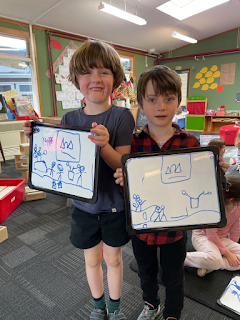
We are just at the very beginning of this cycle. In fact, we're almost in a pre-inquiry stage, where we're fuelling up our inquiry by reading and exploring lots of different fairytale stories. These are stories that most of us already know well, but can be told in many different ways. We are experiencing some of these different retellings, thinking about the characters, making art, building and making, and doing some of our own writing, too. This week, we have begun exploring Jack and the Beanstalk. Here we are, building a beanstalk for Jack (and we'll be planting some beans this week, too).


From these early experiences, we will begin to consider what questions we have about how these stories can be told. We will find some new ways to tell these stories ourselves and - really important - share them other people.

Keep an eye on the Blog and Seesaw as we move through our Inquiry process and share our learning and stories with you. And do ask your child to tell you the stories they are learning at school.

Friday, 17 December 2021

Last Blog Post of 2021

 Wow! What another amazing year at Worser Bay. Here are some highlights...


And something from the staff...


The Year 6 item...

Thursday, 11 November 2021

Anyone for tennis (or soccer)?

This week, we all joined a tennis taster session, and some us us also had the chance to try some soccer. It can take Bravery to take the plunge and try something new, and it was great to see our Autahi children responding with Zest to the challenge.

On Monday, in beautiful sunshine, we welcomed Vojdan from Miramar Tennis Club. Vojdan coached us in some tennis basics, working on our coordination and beginning to control at tennis ball with a racket. It was fun - and a great challenge - to balance the ball on our rackets or take a tennis ball for a controlled 'walk', using a racket to roll it along.


Later in the week, we had a visit from Maia from Capital Football. Maia is keen to get more girls in Wellington involved in soccer. All the Autahi girls had the chance to try out some soccer skills with Maia with chasing, ball control and goal-scoring games. There was a lot of Zest and Love of Learning in our group. 


Look out for more sports opportunities at school for your child as we go into 2022.


Thursday, 4 November 2021

Seasons: our new inquiry

This term, we've embarked on a brand new inquiry into the seasons of the year.

In this blog, you'll get a taste of how our thinking has evolved so far, and some background to some of the ideas that our Autahi students might be asking you about at home. I'm also going to try to give you a sense of how Inquiry learning works in our space.

Here is our inquiry model. You have probably seen it on our classroom walls. Sometimes an inquiry can take us around the cycle a few times.


We begin with 'I am curious'.


This is a questioning and wondering phase of the cycle. Sometimes questions arise spontaneously from children's interests. Sometimes, we try to give the children experiences to pique their curiosity. For this inquiry, we went to the theatre to see the show 'Seasons'.


After the show, we did lots of chatting and retelling about our favourite parts of the show. We talked about what we know about the seasons. We thought about the weather.


And also about the different creatures at different times of the year, like Tui laying their eggs in spring - and spiders (the enormous, hairy spider in the show was a big hit!).


We began to collect and share our questions about the seasons and add them to our inquiry wall. Lots of people are interested in the sun, for example.
We know that there will be more questions to add as we learn more.


We realised that we all mostly know that there are four seasons in New Zealand but we're not totally sure about how nature changes in each one. We did some seasons art to help us to think some more about this problem. 


We started exploring our current season, Spring, by doing some planting and growing.


We also went down to our beach to see what nature is doing at the seaside right now, and we've been sketching hedgerow plants from around our school.


We have also begun to respond to some of those questions about the sun, for example who made it and what is it made from? Why is it hotter in some seasons and cooler in others? Here we are having a go at some fiery sun art.


Our questioning and exploring phase continues, and you might find that your child comes home with some questions and ideas prompted by our topic. Ask them about what we've been doing at school and have a chat about their thoughts. Please do feed back to Beth and Carl as we'd love to follow up their wonderings at school, too. That way, we can all live this rich inquiry topic!